Saturday, December 27, 2014

Clever, yet Foolish::Unsusceptible, yet Vulnerable

Double Indemnity, Baby

Kayla Christine Steward

December 27, 2014

1. In film noir, many of the male leads are weak, frustrated men. While you are watching Double Indemnity, make a mental note of Walter Neff's characteristics. What kind of man is he? What is his relationship like with women?

Double Indemnity is a film noir filmed in 1944 directed by Bill Wilder.  In this movie, wickedly greedy and vulnerable man by the name of Walter Neff, is seduced and trapped by a cold and evil woman known as Phyllis Dietrichson. Walter Neff is Phyllis Dietrichson's insurance agent and she uses his position to her advantage. She, in result, manages to seduce Neff into murdering her husband and obtaining her husband's accident policy. The plan goes accordingly, but after time goes by, Neff and Dietrichson begin to become suspicious of each other and of each other's motives. The plan, in turn, becomes even more complicated when Walter Neff's boss, Barton Keyes who is an insurance investigator, takes the investigation of the murder into his own hands. As the movie moves forward through the flashback's from Walter Neff's point of view, each character seems to be introduced to their predetermined fate, which in time leads to Phyllis and Neff both killing each other, and Keyes finding out that the crime Neff committed was not an accident.

With the knowledge of the synopsis of the movie, it is now important discuss the characteristics of Walter Neff, what kind of man he is, and what his relationship is like with women.

When it comes to Walter Neff, he is perceived as a very ordinary, but well known and successful insurance salesman. Throughout the movie you begin to see how he appears to be a little conceited, always ready to project his understanding of how insurance works, and is eager to display and prove how smart and clever he is, especially when it comes to covering up his crime. He is very blunt and direct, but he does it in a way that is almost satisfyingly flattering and appropriate, with also a hint of sarcasm. Some of the phrases he uses in the movie are, "Suppose you get down off your motorcycle and give me a ticket", "Same chair, same perfume, same anklet", and "Yes, I killed him. I killed him for money- and a woman- and I didn't get the money and I didn't get the woman. Pretty, isn't it?". In these phrases, he tends to use a "matter-of-fact" tone, and almost facetious, but he does so in a way that it is calm and collective enough to keep whoever he is talking to hanging onto every word he says. He possesses an a image of a sarcastic, yet clever gentleman, but in turn, this leads to his ultimate downfall.

When it comes to women, Walter Neff knows his way around pretty well. His sadistic and clever charm tends to woo the hearts of many dames and in turn, leads to him being a sly, yet handsome heartbreaker. However, when he meets Phyllis Dietrichson, he figures that she is just another pretty face waiting to get a glimpse of Mr. Walter Neff. What he doesn't realize, is that Mrs. Dietrichson has another view on their relationship. In this situation, it is almost as if Neff and Dietrichson switch roles, and now the woman gets to play the role of the hard to get man. By this occurring, Neff becomes weak and vulnerable, and Dietrichson swoops in and takes the opportunity being given to her. His relationship with her compared to other women is different because it's no longer just a one night stand or fling, it has turned into a complicated love cover up in which he has to fight and sneak to keep it going strong. I believe the real significance of this relationship is that Neff is use to relationships and issues being easy to overcome and solve, but when it comes to the crime he and Phyllis Dietrichson committed, he is in a hole and can no longer use his charm and good looks to dig himself out.

Saturday, December 6, 2014

Three Witches and Their Late Night Flicks

Three Witches and Their Late Night "Flixes"

By:Kayla Steward

Hello and welcome to the Flicks of the Witches! We are the witches from Macbeth, and this is our compilation of our favorite movies to watch when we're not busy prophesying and trying to fix the problems of mortals debating on whether to choose life or death. You'd think people would get the idea that whether or not they know their fate, they're going to end up fulfilling it anyway! But, back to our queue! 
This queue is compiled of our top four most favorite movies of all time. Each movie is so very relatable and fits the needs of us as witches. We are constantly tired of watching these stupid romantic movies and comedies that are so unrealistic and don't conform to our needs of a good flick. But now we have found five movies that not only can we watch over and over again, but are perfect escapes from constantly having to worry about everyone's needs and that give us a sense of understanding. As if the creators of each movie knows exactly how we feel and how underestimated we are as witches!

Hercules:

Now this movie is for children, and we know this. But it is absolutely entertaining and brings humor to us as witches! We love how as soon as the witches come into play, the movie automatically deepens in suspense. The way the witches grip Hades on to each word of their description of his fate against Hercules is scrumptious. The way they build him up to think he will rule, but will soon be defeated by Hercules is prices. Of course the overall movie is very kid-friendly, yet satisfyingly amusing, it still make us as witches still feel like we are in control and that we have so much power when it comes to the fate of others. The witches in this movie are very stern, yet clever. They tell Hades what he wants to hear and also what he needs to, but it is so very relatable how it all turns on him and no matter how he tries to avoid his fate, destiny is right there to kick him in the butt. We recommend this movie to any powerful woman, or even man, who love a good movie that understands what it's like to be a clever witch, with a keen sense of humor and entertainment.

Twitches:

Twitches is probably one of the most ironic of movies for witches to watch, because in this movie, not only do the twins not want to be witches, but they when they do realize they have to be witches, they use their power to protect the ones they love. Granted, we are all a bunch of magic suckers for a good family movie, but we also enjoy a little sense of relief and difference. We as witches aren't all about power and fate, we also like to have fun and help the people we love. The three of us treat each other like sisters. Triplets if you will! This movie was gripping and moving, but also very powerful. Even though the girls didn't to be witches, they put aside their wants and needs for good of their mother's life. It teaches a lesson to all witches out there that being a witch isn't all about cursing people and casting spells, it's also about protecting one another, no matter the cost. We loved the separated at birth, but bonded by magic theme. It really made us appreciate the bond we share as witches even more.

The Originals

Okay, so this series is probably our all time favorite series. Not just because of the huge variation and percentage of witch in this show, but also because we all have a sweet spot for a good-looking vampire or werewolf. Shh, don't judge! But anyways. We all love this series. Each episode has you gripping to the edge of your seat. The suspense is killer and the twists are spectacular. Each episode leaves you hanging at the end, and it's funny because we could very easily conjure up a spell to figure out what the next episode is about. But what fun would that be! The show is very realistic and shows much appreciation to witches everywhere. The use of nature and the idea that nature and our ancestors are what fuel our magic and keep us strong and powerful. We as witches are forced to use nature as our power sources, and many times mortals underestimate that. But not this show. This show shows so much appreciation and recognition of the hard work we put in into keeping the balance of the world even and steady. We recommend this to anybody, but especially witches when they're feeling a bit neglected or under appreciated.

The Crucible

Now you might find this one a bit ironic. Considering the fact that the entire movie is about exposing fake or real witches and murdering everyone who claims to be a witch or have accusations made against them about being witches, but anyways.This  movie is about romance, which is something that we aren't very fond of, but it's not too romantic to the point that we have to stop the movie. We enjoy this movie not really for a reason at all, but the fact that it makes us appreciate how appreciated witches are in our world. In this movie, if you're a witch, you're automatically deemed evil and cruel and doomed to cast hell upon every creature with a pulse, but in our world, we are the help. The closure. The givers. We do not take. If someone is in need of a prophecy or a spell to make some of their troubles go away, we will fulfill those needs and wants, within circumstances at least. This movie has you questioning constantly whether or not the girls are faking the sorcery "cast" upon them, or if it's real. It's a movie that doesn't involve a lot of action. but not a lot of talking either. It makes you root for, ironically, the mortals, rather than the "witches". We recommend this movie to anyone, but specifically witches. Especially after a long day of nonsense rhymes, catching frogs and leaves for potions, and the constant repetition of the phrase "bubble, bubble, toil and trouble".

There you have it! It is a short list, and may grow in the near future, But if you're a witch or you're into the whole witch-vibe, you now know where to look for a good "Witch-Flick" for the night! Stay tuned next month for more of our reviews as the "Three Witches and Their Late Night Flicks!"

Sunday, November 16, 2014

"Power corrupts and absolute power corrupts absolutely"

Power Corrupts

Shakespeare's Macbeth

Kayla Christine Steward

November 16, 2014

This statement, "Power corrupts, but absolute power corrupts absolutely", brings light to the thought of power having the ability to contaminate or ruin one's mental/physical being through their beliefs, actions, personality, and morals. As soon as one lets power into their life, if they don't have self-control and have the ability to stay humble despite the advantages they may have, it can control them and eventually take over them. Though, does it depend on how sane one is? How insane someone is?


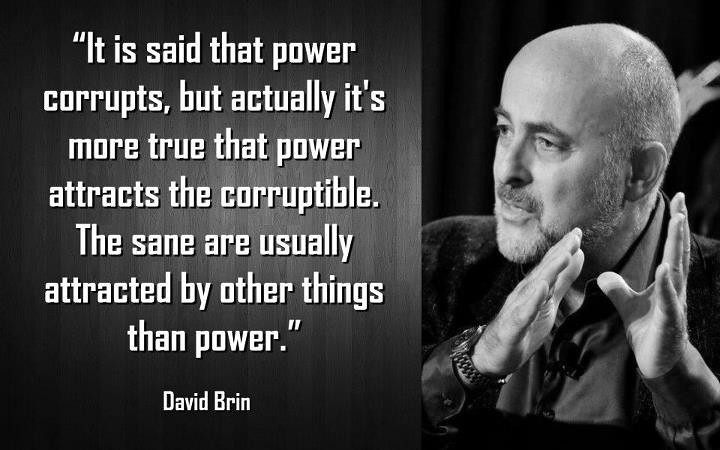
https://www.flickr.com/photos/57037724@N03/8207444408/

In this picture, David Brin uses part of the original quote of "Power corrupts and absolute power corrupts absolutely", but it goes further on to say "It is said that power corrupts, but actually it's more true that power attracts the corruptible. The sane are usually attracted by other things than power". This quote can easily lead viewers to question, was Macbeth insane? He wanted to be powerful, and he was willing to do anything to receive it. "And such an instrument I was to use. Mine eyes are made the fools o' th' other sense or else worth all the rest" (Macbeth, 2.1) In this quote Macbeth was talking about his vision of the bloody dagger that he was going to use to kill King Duncan in the play, Macbeth is constantly going back and forth with himself on whether or not to kill King Duncan. Of course, he supports the original quote by doing the evil deed in order to get what he wants-power.
Macbeth may or may not have been completely insane before, but the greed and thirst for power took over him and pushed him to do something completely immoral.
We face this within ourselves everyday. Every day we are constantly battling the evil within inside us all. Some of us are strong enough and willing enough to fight for the good to keep coming out and for the evil to stay hidden and away, but, unfortuneatly, some of us lose our battles. Some of us become so tired of fighting that we just let the greed and thirst for something we want so bad in our lives and the will to do whatever it takes to get it, takes over. It consumes us. That being said, was Macbeth consumed by his thirst for power? Or was he just tired of constantly fighting his battle?

Sunday, October 19, 2014

An Unintentional "Deadly Sin"


France, April 1999. Moet Hennessy

An Unintentional "Deadly Sin" 

By: Kayla Steward

Deadly Sin: Gluttony

 Imagine you are flipping through a magazine and you happen to come across this advertisement. You see the young woman eating what seems to be a handful of cherries. You then look down at the purse that is next to her and see it is also filled with cherries that have rolled out onto the table she is resting on. You don't think twice about what's in the picture, but you do wonder what the picture is advertising. Louis Voutton. Most likely, you will think for a second about how the product of the ad and the ad relate, but then you'll continue to flip through the magazine.

Now go through the whole analysis process of the ad just like you did in the first scenario, except take a longer moment to think more about what is indirect, rather than what is directly seen within the picture. Not only take a moment to go into deeper thought, but think through a religious perspective. You then realize that this ad is revealing something most people won't catch on their first glimpse- a sin. A deadly sin. Gluttony, to be more specific.
 Gluttony is the sin of over eating. In the picture, the woman is clearly eating more than enough of the cherries. The author is most likely trying to appeal to an audience who will think more about the ad just like you did in the second scenario. They show a woman over eating out of a nice purse to most likely get viewers to want to over-buy their products. They want them to constantly want their products, just like the woman wants the fruit within the picture. The author is most likely trying to appeal to an audience of women that fall in the higher middle class to upper class, just because the company of the ad is an expensive company and they are advertising a woman's purse. This audience of women most likely includes women who wear expensive clothing and are going to want to buy the purse to keep their reputation of being able to afford and wear expensive clothing. The downside to this ad, keeping the audience in mind, is that it can come off as a bit stereotypical. Men can have gluttony and can have the desire to be stylish and buy expensive things, but since it is your typical women's purse, they choose to have a woman wearing nice clothing. This can also be stereotypical towards women as well, making them seem greedy, or avarice in the fact that they want people to notice they are able to buy and pull off such expensive brand items. The ad is meant to make the audience want to buy their product, without even thinking about the effects it will have on it's audience, nor the image they are sending to the viewers of the ad, which in my opinion, is not a very good image. But my opinion is my opinion. I personally would not buy a purse that expensive, especially for a company that is possibly biased towards other social classes that are not within their intentions.


Sunday, September 7, 2014

 Othering Our Society

http://photos.wingyounghuie.com/p709406511/h7651beea#h7651beea

(The picture didn't have a description,  nor did it allow me to copy and paste the picture. So here is a hyperlink for the picture I used for my blog post!)


Picture this scenario in your mind, just for a moment. You wake up one morning and look at yourself in the mirror. You realize that you need a haircut so you decide to head over to the local barber shop to get a trim. As you walk into the barber shop, you see a man, most likely middle-aged, getting a haircut. You notice the content he has on his face as the barber, in deep focus, buzzes each little follicle of hair off of his head, one by one. You raise an opinion in your head of how the barber is buzzing his hair off and you then form your own opinion as to whether or not the work the barber is doing on the man’s head is nicely done. As you’re walking past, you then hesitate. Before continuing your walk, you stop and notice the sign the man is holding. You read the sign and speak the words aloud in your head, “I am a far minded person. I wish the world would do the same”. You ponder on this quote and you think not of the reason the man is holding the sign, but you think of the reason as to why the sign he is holding has those two sentences scrawled onto it. You take a few moments to yourself to think on it, and continue your walk to an open chair, because you know you will probably never see that specific man, holding that specific sign, with those specific words scrawled onto it, ever again. 

Now go through the entire scenario again and actually focus on the man and the words on the sign he is holding. It is almost as if he is a representation of an everyday "other". An average "other" getting a haircut and not having the ability to speak his mind, so he is left to writing it on a chalk board and wearing it on his chest. "I am a far minded person. I wish the world would do the same". You realize that this quote is not only representing his loss of the ability to speak his mind, but the fact that someone who isn't able to speak their mind sure has a lot to offer the world with their words. The man's sign is saying I may not be talking, but that doesn't mean I don't have anything to say. At least that is what you infer the man is trying to tell people reading the sign. You realize how amazing it is to see the way society restricts some of the most wise and understanding people in the world, and gives them the label "others" just because they don't necessarily always have the same opinion as we do. We give these people titles in society to make them feel like outsiders and useless to the world so we can make ourselves seem better than we really are. We are no better than anyone if we continue to give people labels just because we aren't always on the same page with each other. If we continue to single people out and alienate them, we will never be able to see outside of our own perspectives. In other words, well never know color in world that is just white and black.

Huie and Atwood both show their perspective of the “others” in similar ways. They make the people feel and seem bigger than they truly feel. They give them a reason to speak up and speak their mind. They give them not only ears to listen, or a mouth to speak, but a heart to tell them what to say, and a brain to tell them when to say it. When they are given the opportunity to speak their mind, they speak as they please. They give us insight to how they are feeling and what their opinions are of certain things. They help us see through perspectives other than our own, even if they aren’t as big as the ones we view society through on a daily basis. They give us an insight on the troubles and tribulations they have faced, but also the pleasant memories and experiences they’ve shared with others.  In The Handmaid’s Tale they are considered the “others”, but in our society, they are viewed as “friends”, “family”,  “us”, “we”, “the people”. We are far minded people because we are shown what it is like to be so far from hope, that we might as well give in and give up. We are far minded people not because we don’t stand out above everybody, but because we are able to see through the world through perspectives farther than our eyes can even manage to see. They may be called the “others”, but who they are, and what they have to offer the world, is far more important and meaningful than the societal labels given to them.